Competitive Analysis framework of The Indian Express, Hindustan Times, The Times of India.
The Times of India is the leader in terms of Cost, as it caters to a larger audience and has a high brand value.
The Indian Express has a seperate target audience and it works really well digitally. It’s social media and e-papers use a differentiation strategy which works in its favour.
The Indian Express focuses on a wide market, just like TOI and Hindustan Times.
Competitive Analysis framework of Rapido, Vogo and Bounce
In terms of Cost leadership Bounce works the best, because it uses scooters. Rapido, on the other hand has a driver and hence it is cost effective too considering that.
The focus of all three companies is to reach to most parts of the country.
Competitive Analysis framework chart of Colgate, Pepsodent and Oral B
Colgate is the market leader, both in terms of market share and cost leadership. Colgate uses economies of sale to produce cheap products for the consumers.
While Oral B has a huge range of toothbrushes including electronic toothbrushes; Colgate has stuck with it’s basic products with few new products (in toothpaste). This move of Colgate might not work well for everyone, but for the brand it brought in reliability from consumers. It’s differentiation strategy is to stay the same.
Colgate focuses on killing germs and targets families. It’s focus is on oral care and hygiene.
Comparative Analysis Framework of Airtel, Jio and BSNL
Reliance Jio is a leader in terms of Cost differentiation. It provided free services to consumers for a long time.
The differentiation strategy of Airtel is its reach whereas for Jio, it is its fast internet. BSNL is usually preferred for landlines.
Since the telecom sector caters to everyone, therefore no specific target audience is there. Although, while establishing a reach to a desired area, the company targets people of that area. For example: Airtel ads show network connectivity to almost everywhere in India. Jio, on the other hand focuses on the internet benefits.
Competitive Analysis framework chart of Amazon, Flipkart and Paytm Mall
The Cost Leadership strategy of the three are quite similar. All three has a range of products which allows the consumer to choose. Due to inefficient logistics, Paytm Mall lacks a little behind.
Companies that use Focus strategies concentrate on particular niche markets and, by understanding the dynamics of that market and the unique needs of customers within it, develop uniquely low-cost or well-specified products for the market. Due to wide range of products they concentrate on each consumer. For example: Amazon for its Prime focusses on 20-40 age bracket, while for the ecommerce it targets consumer based on product.
The differentiation strategy for Amazon in India is “Apni Dukaan”, whereas for Flipkart it is good quality and “Assured products”.
Even if you’re an astronaut who has been in space for the longest time, you would know about Amazon or at least heard about it. Amazon is an American multinational technology company. It has an ecommerce site, a video streaming platform (Amazon Prime), a platform for eBooks (Kindle), a virtual assistant AI technology (Alexa), Amazon Music etc.
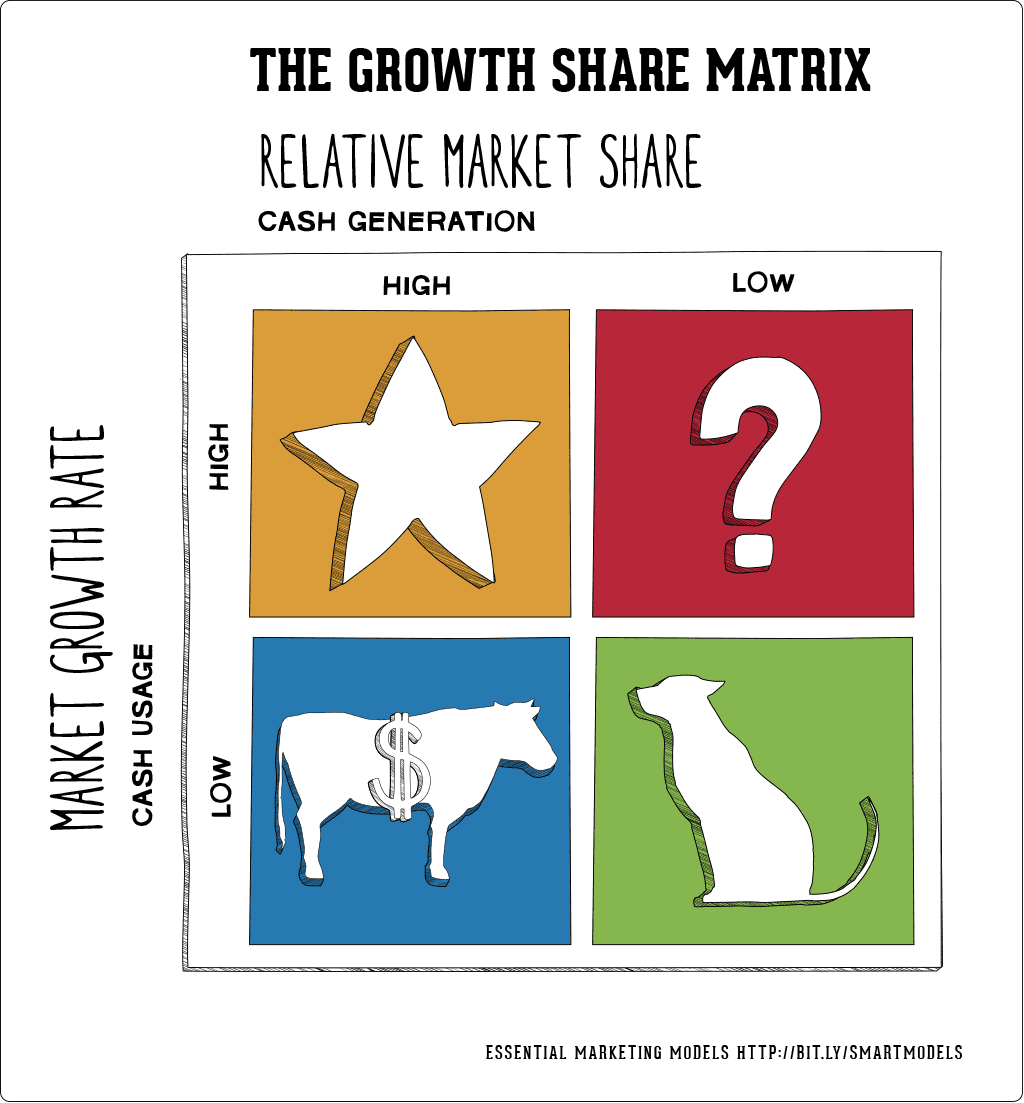
In today’s blog we’re going to be discussing the BCG Matrix of Amazon with special reference to P-M grid. But before that let us understand what BCG Matrix means. This Matrix helps businesses design a long term strategic plan. It also helps them consider growth opportunities by reviewing its portfolio of products to decide where to invest, to discontinue or develop products. It analyses market growth and share based on which there are four quadrants:
Stars – The products in the upper left hand quadrant has the highest market share and growth. Although ‘star’ products bring in a lot of profit for the brand, it also requires good investment.
Question mark – They have low market share and a high growth rate. Such products have the potential to grow rapidly if the company invests in them.
Cash Cow – Products in low growth markets with high market share fall under this quadrant. They generate more revenues than they consume and are the market leaders.
Dogs – These are products with low growth or market share. Businesses are usually advised to dispose off these products.
PM Grid, or the product market grid is a portfolio planning tool for identifying a company’s growth opportunities through four stages based on existing and new products and markets.
P-M Grid
Amazon Music had 15% market share, as compared to Spotify which had 36% in 2019. Prime Video has Netflix leading the market share. Both these products have low market share but high growth rate, therefore it comes under the Question mark category. These products can become ‘star’ ,if they receive investment. Since both prime and music were launched into the market when their rivals were already present, they have mostly been cash cows. Because Amazon was essentially an Ecommerce giant, both these products were new and launched in a new market. Thus, it was a Diversification.
Kindle and Alexa are both Stars. Kindle might not generate as much revenue as other products, but it is the market leader under eBooks category. Alexa receives competition from Google Home but still enjoys high market share, and brings in good revenue. Both these products were new but the market wasn’t, hence it was a product development.
Amazon’s ecommerce is a star too, because it leads the market share. In India it receives competition from Flipkart, but has a higher market share. Amazon was launched in 1994, it was the first ecommerce website. Since both the product and market were new, it comes under Diversification.
Amazon does not have any product that falls under the category of dog, since most of its products have a decent growth rate.
While writing this blog I understood the BCG Matrix better, and also realized how important it is for companies. It will not only help a company figure out the products/services working for them, but also analyse and plan for the future.
The Social Structure, written by Aaron Sorkin and directed by David Fincher is a biographical drama about Mark Zuckerberg. Through the character of Zuckerberg, the film also takes us along the journey of the social networking giant, Facebook.
Zuckerberg, along with his college friend Eduardo Saverin, are the founders of Facebook. Mark was emotionally hit after his girlfriend broke up with him, to take his mind off it he made a website to rate girls. The website grew extremely popular overnight and proved to be an effective social experiment which ultimately led to Facebook.
Facebook’s story is not conventional. It started with an idea of ‘taking the entire social experience of college and putting it online’. The idea was to provide a platform for people to connect. Initially, it was just available to students of Harvard, but later other universities like Yale and Columbia were included too.
The platform grew extremely popular within a very short span of time. Getting to be friends with whoever and whenever you want, looking at their profile (Picture, Relationship status etc.) wasn’t just new but extremely exciting for students. Soon, ‘Facebook me’ became a phrase people used to connect.
A lot of us might think that Facebook is an extra-ordinary idea which was invented over night. But neither of it is 100% correct. Yes, it was an idea which required understanding and observance, but the motive was simple : a platform for people to connect. Mark wanted Facebook to be clean and simple, it only functioned on information provided by the users.
Do you think ads are cool? If yes, then you and Zuckerberg are not aligned. Mark thought that advertisements will not go well with the reputation of the brand. Ads for Facebook is ‘ like you are throwing the coolest party on campus, and someone saying its gotta be over by 11’. This approach of Facebook was unconventional. Unlike Steve Jobs who lured John Scully away from Pepsi to apply his marketing skills at Apple; Mark believed that Facebook doesn’t need advertising.
Facebook as a product, drove its audience emotionally. It started with people getting in touch with friends to making new friends (without geographical boundaries).
Even though Facebook did not market itself, it has taught us some important marketing lessons:
Keeping it Simple and Clean : We often see that in order to portray themselves differently, brands over do it sometimes. But for Facebook, the idea was simple. It was SIMPLE.
Engaging the audience : Word- of- mouth marketing worked best for the brand, because the product itself required people to connect. It gave them a chance to make friends online for free. If this isn’t cool, I don’t know what is? (talking about early 2000s).
The brand story of Facebook is extremely inspiring, not just because of the hardships it faced, but because it teaches us the importance of having a vision and passion. Think about it, a brand which never felt the need to market itself is now providing a platform to millions of companies to advertise. That is the power of Facebook.
If you’ve been following my blogs you know that I don’t do well with technology, primarily because I don’t understand it. But one thing I understand and believe in, is passion. Recently, I watched the movie Jobs, it is a biographical drama based on the life of Steve Jobs, co-founder of Apple Inc (for few of you who don’t know). Although I believe that the movie could have been better in terms of storytelling, you cannot not like Steve’s character.
As someone who likes to understand emotions and believe in its purity, it was really amazing and insightful to witness a character so powerful ( both mentally and emotionally). The character unapologetically expressed anger, frustration, jealousy, love, passion etc., which is probably one of the reasons Apple is what it is today. A lot of people might feel that the movie shows Jobs’s character in a negative space, but I think it is extremely empowering when people express what they feel.
The idea behind the name Apple was, it has to be “something you see and you’re like, Man! I just gotta have it”. I have never thought of an Apple being more than a fruit, forget about it being ‘simple and sophisticated’. Jobs was not willing to settle, neither was he afraid of failure.
The greatest artists like Dylan, Picasso and Newton risked failure. And if we want to be great, we’ve got to risk it too.
Steve Jobs
The film advocates being different, having passion, fearlessness and most importantly the will to bring in a change. Jobs believed that every small experience helps you do better in life and helps creativity to flourish. He did not complete his college, took a calligraphy course instead, and went on a cultural tour to India. He never dismissed the value of higher education, but said that it comes at an expense of experience.
Innovation as a term is widely used, but only a few have managed to deliver it like Apple.
How does somebody know what they want if they haven’t even seen it?
Steve Jobs
Making something innovative and different comes at an expense of rejection, but that must not stop us, and it didn’t stop Steve. He was removed from team Lisa, but he made a less important project – Macintosh, the most important one. “We’ve got to make the small things unforgettable,” he said.
Apple today as a brand has established itself, people want to own it and consider it as an investment. Every product of the brand comes with a trust factor and quality assurance. The brand story of Apple is something most of us would relate to and understand. The movie celebrates, ‘the crazy ones, the misfits. The rebels. The trouble-makers. The round pegs in the square holes. The ones who see things differently…they change things. They push the human race forward. And while some may see them as the crazy ones, we see genius’ .It is a story of struggle, passion and creation.
Online shopping has witnessed an exceptional surge during the pandemic, which has resulted in shopkeepers suffering huge loss.
Coronavirus has put the whole world in a state of lockdown. It has had a huge impact on every industry, be it positive or negative. One industry that has benefitted the most is the E- commerce. Consumers prefer shopping online rather than going out and increasing the risk of contracting virus. Due to this, there has been a significant decrease in sale at stores.
A study conducted by the New England School of Medicine found,”SARS-CoV-2 was more stable on plastic and stainless steel than on copper and cardboard, and viable virus was detected up to 72 hours after application to these surfaces…”. The research also stated that the half-life on stainless steel and plastic was 5.6 and 6.8 hours respectively. Therefore, shopping online reduces chances of coming into direct contact with the virus; and with precautions it is much safer than going out physically. Divya Chopra, a resident of Kolkata said, “I have indulged more into online shopping for groceries and hygiene supplies recently, because stepping out of the house is risky, and they offer good deals”. “The risk of catching the virus from a package that has been moved travelled and exposed to different conditions and temperature is low. You can sanitize your package and keep it aside for 2-3 days”said Sweta Sah, a resident of Purnea.
About 74% small businesses and start- ups in the country are either shutting or scaling down their operation due to the pandemic, according to a survey of startups and SMEs based in more than 90 districts in India. Small and medium business for commodities like jewellery, clothes, grocery, gadgets etc have suffered huge losses. “About 20% of the total sale has gone down due to consumers preferring online medium, especially during Covid-19”, said Ranjeet Agarwal a small town based Businessman.
A study conducted by McKinsey & Company said, “as almost 25 percent of MSME and small- and medium-size-enterprise (SME) loans could slip into default”. The pandemic has made everyone’s life difficult, but with a sudden increase in demand for e-commerce the shopkeepers are suffering. Retail Industry of India accounts over 10 per cent of the country’s GDP and around eight per cent of employment. Therefore, it has a direct impact on the country’s economy.
Amazon works with retailers who use the platform to sell their products online. In April, the company announced the ‘Local Shops on Amazon’ programme “helps customers discover products from local shops in their city from the convenience of their homes, while helping shopkeepers supplement footfalls with a digital presence and expand beyond their normal catchment,” the company said. Gopal Pillai, Amazon India vice-president for seller services said, “What we are saying now more than ever is that we need to step up and help small businesses and local shopkeepers”. He added, “We are committing Rs10 crore in investment to expedite onboarding and training and enablement of these stores to take advantage of this opportunity.”(Source :Mint)
“Although online giants like Flipkart and Amazon promote local businesses to join their platform to increase their sales, but this remains confined to the ones who are either retailers or wholesalers of products and not services,”said Uttam Chopra who offers both product and services to his clients at Samta Computers. Since most Indian Retailers are not aware about technology, it might take a long time for them to adapt to the online mode. Also, some shopkeepers are reluctant to try online medium as they are comfortable in the tradition way of selling things.
On 29th February, 11:34 AM, I received an email, with the subject line “You have been selected for the Master’s programme at Commits”. I was at one of the most crowded areas of Kolkata when the mail was delivered. Although I had been waiting for the response, the sudden happiness I felt while reading it cannot be explained in words. I called my mother first, we both shed tears of joy and then began with the series of phone calls. I didn’t move for a long time, stayed there, dialled everyone I knew, promised my friends a party and then with a permanent smile I continued the walk.
I came to know about COMMITS through a friend’s sister. After which I searched about it online, connected with a few alumni and students, and asked them everything I wanted to. The one thing which stood out for me was the clarity in conversation with everyone associated with the college. I got an opportunity to meet Ranjini Ma’am in Kolkata and talk to her. She patiently told us everything we wanted to know and more.
Today, when I am writing this blog about my first 30 days, it takes me back to my very first day. Due to the pandemic, the first day ‘of college’ wasn’t ‘in college’, but Commits knows how to take up every problem and turn it into an opportunity. From Day 1, we were exposed to the industry with professionals (most of who were our alumni) coming in for orientation sessions, and talking about different parts of the industry. Each orientation session has been no less than a course on it’s own. We get the opportunity to talk to people who have excelled in their field, and listen to them while they share their experiences.
Orientation session with Samarpita Samaddar, PR Director at Bumble India (Class of 2010)Orientation session with Victor Mukherjee, Writer, Lyricist, Director and CEO of Mango People Media (Class of 2007)Orientation session with Koyel Mitra, Editorial Manager at AETN18 (Class of 2011)
Initially, I was reluctant about the concept of online education, simply because a course like Media needs practical exposure. But since I have started doing classes online, all my questions have disappeared. Our classes are a perfect amalgamation of knowledge and discussions.It is more practical than theory. Our teachers here say ‘No question is a stupid question’, we are allowed to ask freely and without any judgement or remark all our questions are answered.
Marketing Class with Sai Sir Journalism Class with Ayesha Ma’am Writing and Editing class with Padmini Ma’am
We have been fortunate enough to have great seniors, who took the initiative to organise an ice breaking session for us. They planned the entire session, and designed posters with interesting themes. It was really fun and interactive. Again, we were given full freedom to say and ask anything we wanted to. Our seniors are very approachable, one of them helped me with my previous college’s issue too.
One of the posters designed by our seniors for the ice-breaking session
Teachers here at COMMITS, are experienced professionals who take out the time from their busy schedule and help us in every possible way. Our academic structure is designed keeping in mind every little detail. Despite being an AVC (Audio-visual Communication) student, I am allowed to learn anything I want to from MMC (Marketing and Management Communication), and vice-versa. Learning has no boundaries here.
My life as a COMMITScion is exactly how I expected it to be and more.COMMITS treats and trains us like professionals, which is why I always wanted to be a part of it. And now, here I am! Learning each day, and moving a step closer to achieve my dream.




 Shivangi